
Why Legacy Visual Inspection Systems Fail to Support Modern Manufacturing
How does the Visual Inspection System Work?
A Visual Inspection System (VIS), also known as a Machine Vision System, automates the inspection task previously performed by human eyes. Here's how it typically works:
- Image Capture: Cameras (sometimes multiple) capture images of each product or component as it passes through inspection.
- Image Processing & Analysis: The captured images are analyzed using algorithms that compare them against predetermined criteria: surface finish, dimensions, presence or absence of parts, correct orientation, and defects such as scratches, cracks, or misalignments. This is the core of the image-based inspection process.
- Decision & Sorting: Based on the analysis, the system flags defective items and either rejects them or routes them for further manual review. Clean items proceed forward.
- Data Logging & Feedback: Inspection results are logged. Over time, these data feeds support analytics and quality-control dashboards that help you identify recurring problems and optimize upstream processes.
With advances in computing power and deep learning, modern systems detect even very subtle flaws with high reliability.
What are the Benefits of Using Visual Inspection System?
Switching to an Automated Inspection System delivers concrete advantages over manual inspection. This includes
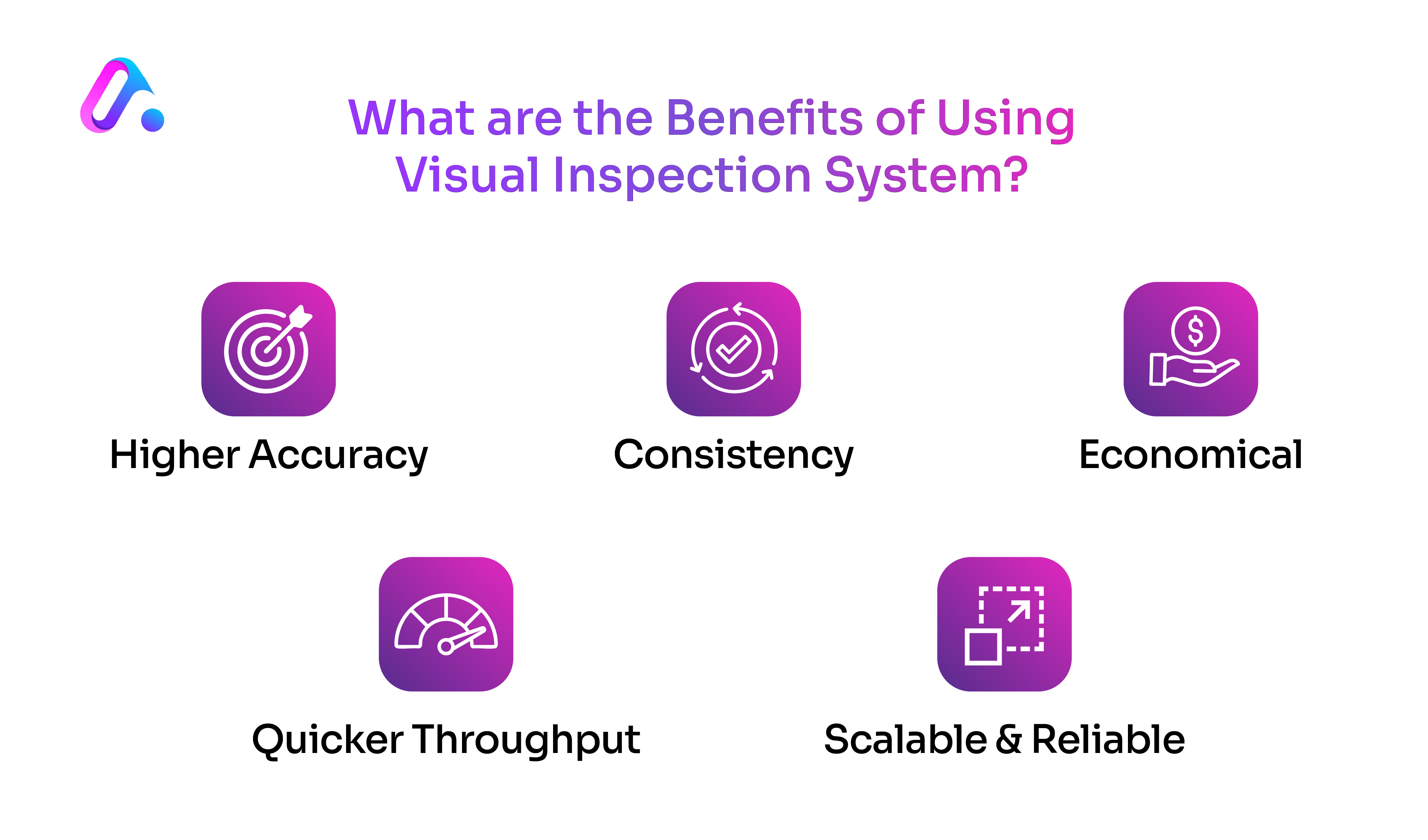
- Significantly higher accuracy: Modern machine-vision installations report 98–99 % defect detection rates, compared to about 85–90 % for manual inspection.
- Consistency and objectivity: Each unit is evaluated by the same criteria, with no variation due to fatigue, shift changes, or subjective judgment. That ensures uniform quality across batches and shifts.
- Speed and throughput: Systems can inspect hundreds or thousands of units per minute, far beyond human capacity. Many implementations report a 40–60% reduction in inspection time.
- Lower cost over time: By catching defects early, avoiding rework and scrap, companies reduce waste and inspection labor costs.
- Scalability and reliability: Automated inspection supports high-volume production without requiring proportional increases in headcount or quality-control staff.
Real World Applications of Industries using the Visual Inspection System
Different sectors benefit from a Machine Vision System even if their products and defect types vary widely. Here are a few key use cases:
- Automotive manufacturing: Critical parts such as transmission components, castings, and assemblies require tight tolerances and defect-free surfaces. One automotive supplier raised their first-pass yield from 89% to 98% using real-time vision inspection. Defect rates dropped by 99%.
- Electronics and PCBA production: In PCB assembly and component inspection, tiny defects such as soldering errors, missing components, and surface scratches matter. Automated Optical Inspection (AOI) systems increase defect detection and reduce false rejects.
- Surface quality and metal/sheet-metal inspection: For metal sheets, castings, or machined parts, surface irregularities, scratches, or microcracks affect performance or cosmetic quality. Vision inspection systems excel at detecting surface defects and ensuring repeatable finish standards.
- Food, packaging, and consumer goods: Fast-moving production lines demand high-speed inspection to verify packaging integrity and labeling, detect contaminants, and identify seal failures. Automated systems deliver the speed and consistency that manual inspection can't.
Because the inspection logic is software-driven, the same system can often be adapted to new products or defect types, speeding up changeovers and reducing downtime.
Presenting a Solution: Smart QC+ for Modern Visual Inspection
If you're looking to bring these benefits to your own production line and want a tool that's not just plug-in hardware, but a full-fledged quality-control platform, then EyRes AI's Smart QC+ solution is worth considering.
- Smart QC+ brings structure, accuracy, and scalability to the image-based inspection process. It lets you define inspection rules with precision, ensuring that every defect category, tolerance window, and decision path is consistent. Rejects and passes follow clear workflows rather than subjective calls.
- Smart QC+ combines image-based inspection with configurable workflows, enabling you to precisely define what counts as a defect and how rejects or passes are handled.
- Smart QC+ plugs into existing production lines without slowing them. It handles heavy throughput and maintains stable detection accuracy even as volumes rise. The system scales without needing additional QC workforce, making it suitable for plants that operate at high speed or run multiple SKUs.
The Business Impact You Can Expect using Smart QC+
Switching from manual checks to a vision-driven workflow powered by Smart QC+ moves you from reactive quality control to predictable, stable output.
- Higher first pass yield because fewer defects slip through undetected.
- Reduced operational cost with lower rework, fewer scrapped parts, and less inspection labor.
- Better throughput and stable quality, even when the line ramps up or introduces new variants.
- Accurate traceability and data-backed improvement, allowing engineering teams to fix upstream issues early and cut recurrence.
Conclusion
Relying on human eyes and manual checks for quality inspection is risky, slow, and inconsistent. As production scales and precision demands increase, that old model becomes a liability.
A Visual Inspection System brings objectivity, speed, accuracy, and scalability. With Automated Inspection Systems now routinely achieving 98–99% defect detection and dramatically cutting inspection times, the business case is strong.
For companies serious about quality, consistency, and profitability under scale, adopting a system like Smart QC+ can be the difference between reactive rework and proactive quality assurance. In the emerging landscape of automated manufacturing and high-volume production, intelligent vision inspection is not just a nice-to-have — it's a strategic advantage.